
Synthetic data is rapidly becoming an essential tool for marketers because it delivers faster insights, lower research costs, and greater flexibility than traditional data collection. However, not all synthetic data is created equal. The three primary approaches — synthetic personas, synthetic panels, and synthetic populations — are designed for different types of decisions. Understanding the strengths and limitations of each is critical to selecting the right approach and ensuring confidence in the resulting business decisions.
Why Synthetic Data Matters
More marketers are incorporating synthetic data into their decision-making as its advantages become increasingly clear. It enables organizations to generate insights faster, reduce research costs, fill gaps left by incomplete or low-quality data, and test ideas without waiting for lengthy fieldwork.
Synthetic data is generated from one or more primary data sources using statistical and machine learning techniques to create realistic representations of people, behaviours, and markets. Rather than replicating actual individuals, it reproduces the statistical patterns, relationships, and characteristics found in the source data, making it inherently privacy-safe while remaining highly representative.
For marketers, synthetic data is particularly valuable when first-party data is incomplete due to privacy restrictions, declining survey response rates, bot traffic, or respondent fatigue. Because synthetic datasets are complete and readily available, they integrate easily into modern marketing platforms, allowing organizations to model scenarios, evaluate strategies, build business cases, and generate insights without relying on personal identifiers or repeated data collection.
Three Types of Synthetic Data
While all synthetic data shares the same objective of recreating real-world patterns, the different approaches serve distinct purposes.
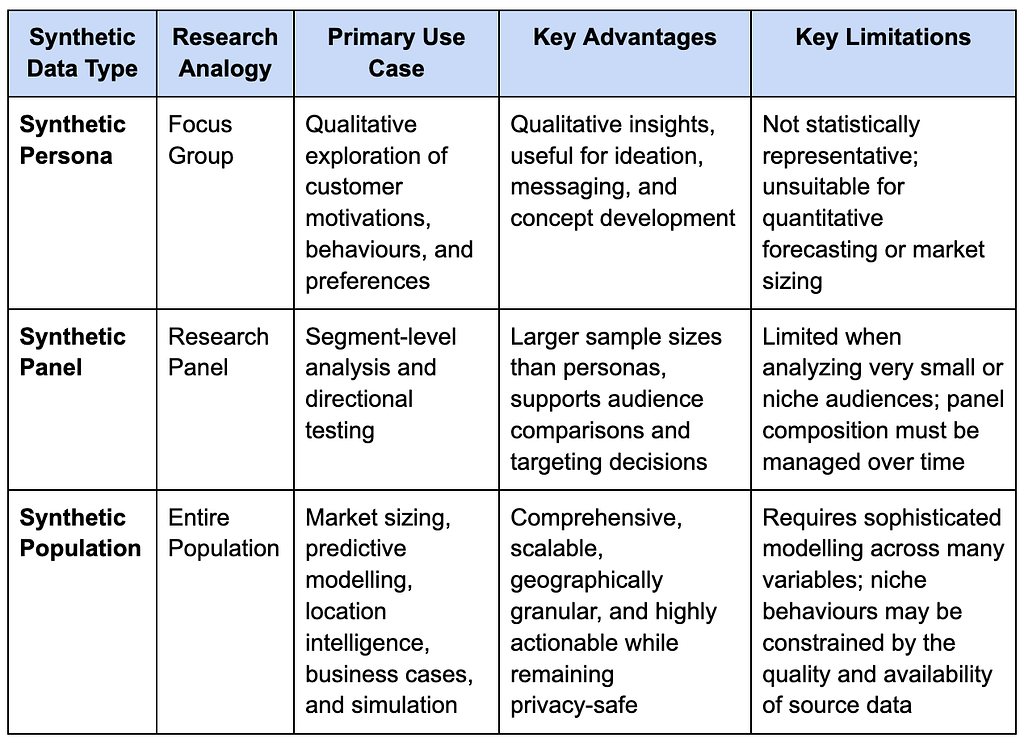
Synthetic Persona
Research Analogy: Focus Group
Primary Use Case: Qualitative exploration of customer motivations, behaviors, and preferences
Key Advantages: You get qualitative insights that work well for ideation, messaging, and concept development
Key Limitations: The data isn’t statistically representative. Don’t use it for quantitative forecasting or market sizing
Synthetic Panel
Research Analogy: Research Panel
Primary Use Case: Segment level analysis and directional testing
Key Advantages: You get larger sample sizes than personas, plus support for audience comparisons and targeting decisions
Key Limitations: This approach has limits when you analyze very small or niche audiences. You also need to manage panel composition over time
Synthetic Population
Research Analogy: Entire Population
Primary Use Case: Market sizing, predictive modeling, location intelligence, business cases, and simulation
Key Advantages: This method gives you comprehensive, scalable, and geographically granular data. It stays highly actionable while remaining privacy safe
Key Limitations: You need sophisticated modeling across many variables. Niche behaviors may be constrained by the quality and availability of source data
Choosing the Right Approach
Selecting the appropriate synthetic data source begins with understanding the decision you are trying to make.
If your objective is to explore ideas, validate concepts, or gain directional feedback, synthetic personas and synthetic panels are often the most appropriate choice. They provide rapid, cost-effective insights that help marketers refine strategies before committing significant resources.
However, when decisions carry greater financial or strategic impact — such as developing propensity models, forecasting demand, evaluating media investments, optimizing retail networks, or analyzing hyper-local markets — a synthetic population provides a much stronger foundation. Because it represents the full market rather than a sample, it supports statistically robust analysis, granular geographic modelling, and complex simulations that are difficult or impossible to achieve with smaller synthetic datasets.
The Bottom Line
Synthetic data is not a single technology but a family of approaches, each designed for a different level of decision-making. Synthetic personas help marketers understand why consumers think and behave the way they do. Synthetic panels help determine how different audience segments are likely to respond. Synthetic populations enable organizations to quantify what will happen across an entire market and estimate the business impact of alternative strategies.
The most effective marketers are not asking whether they should use synthetic data — they are asking which type of synthetic data best fits the decision they need to make. Matching the methodology to the magnitude of the decision is what ultimately transforms synthetic data from an interesting research tool into a strategic competitive advantage.